2014-2. Archaeology. New Trypillian Bird-Shaped Rattle from Savran Region
An unusually well-preserved bird-shaped rattle from Hetmanivka 1 (Savran region) offers rare evidence for Trypillian sound-producing zoomorphic objects. Technical description and X-ray imaging place the find within Balabina’s typology and refine its significance for regional distribution patterns across the Southern Bug corridor.
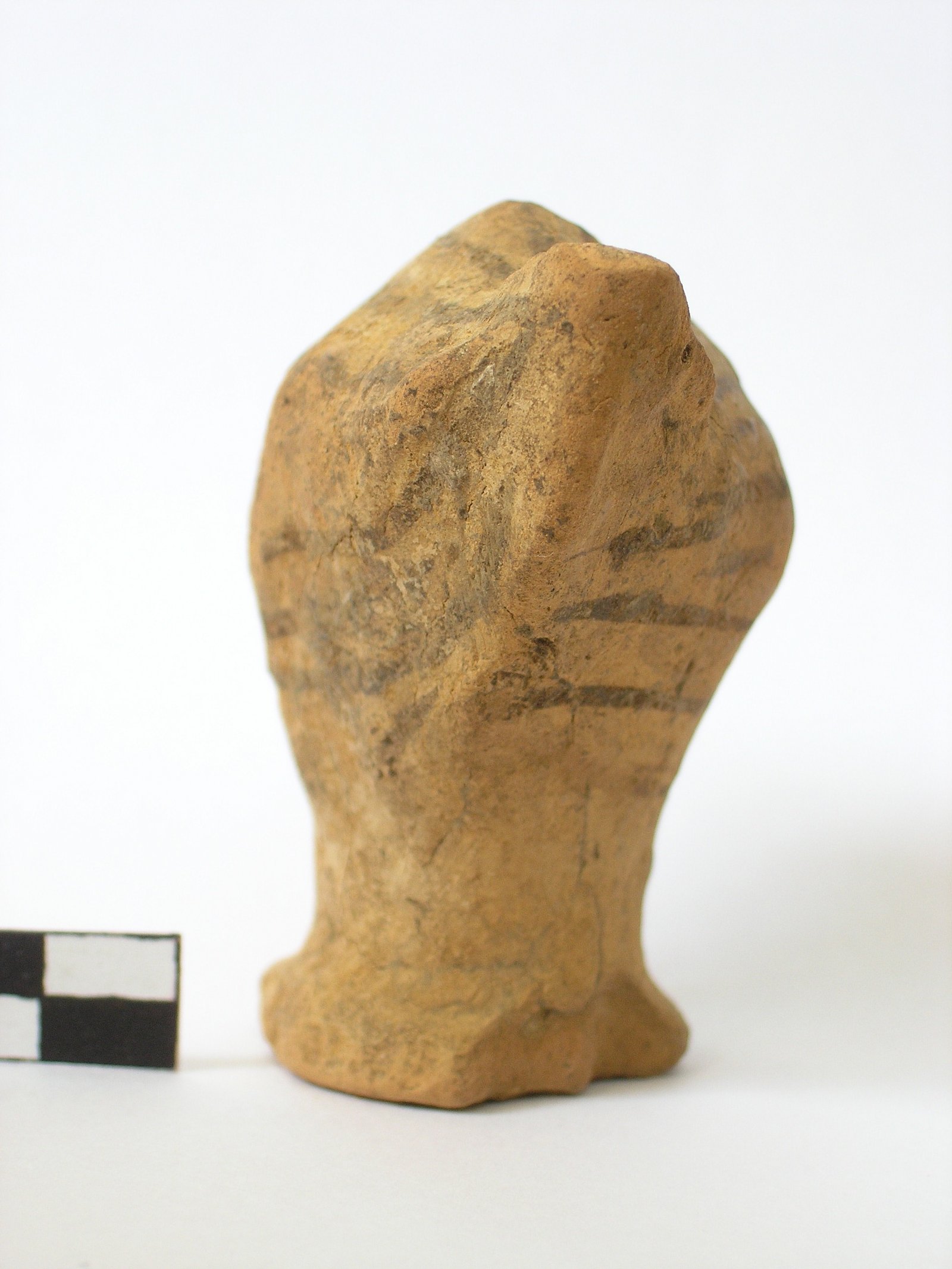
Figure 1-2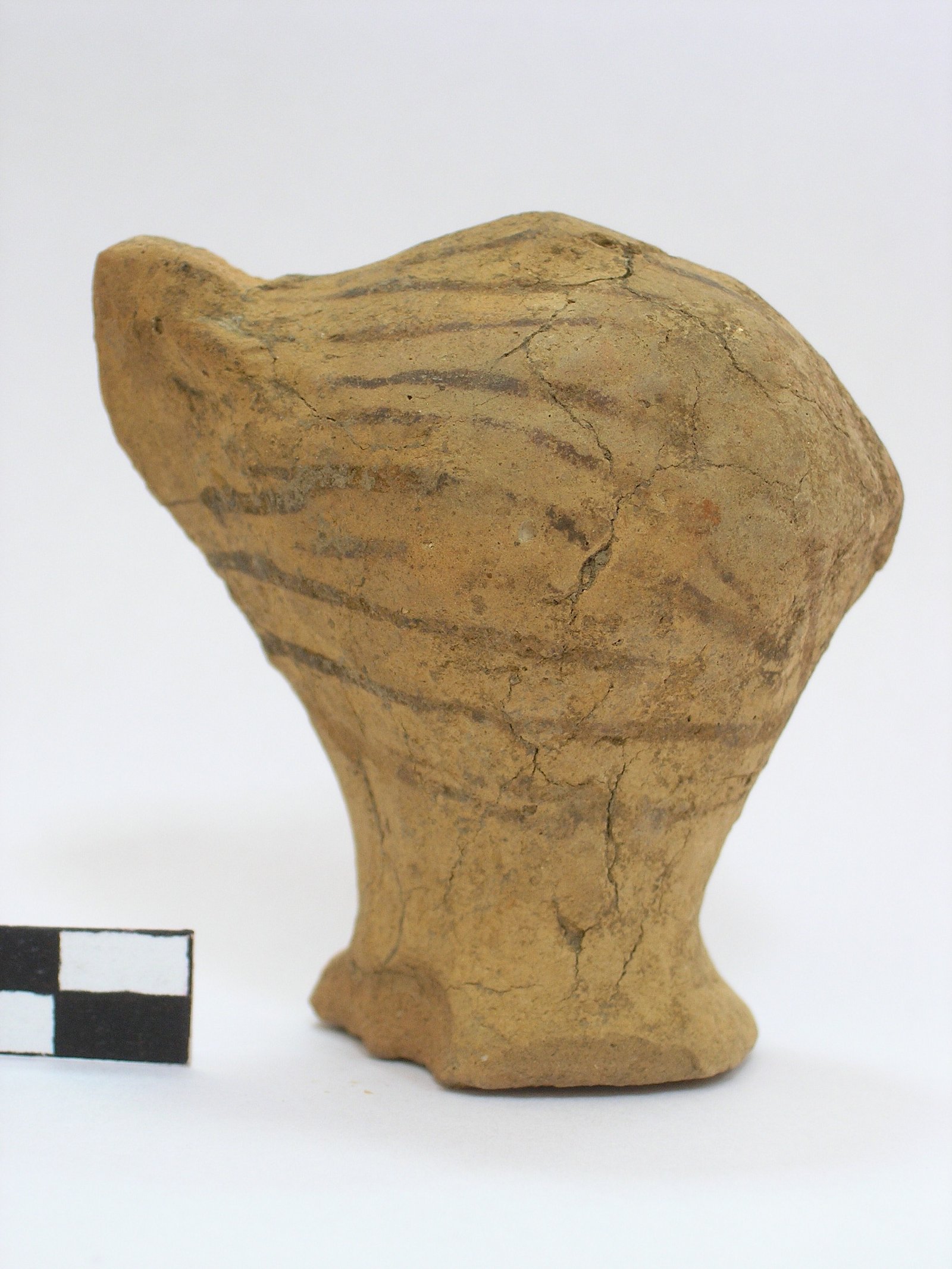
Kiosak D., Denisuk V., Polischuk L.
New Trypillian Bird-Shaped Rattle from Savran Region
Rattles of various shapes are quite a common feature of Balkan Chalcolithic cultures. Some of them are ornitomorphic. Around 30 ornitomorphic rattles come from sites of Trypillia-Cucuteni cultural entity. Mostly they are known in fragments. This paper presents an almost complete bird-shaped rattle found in 2011 in Savran Region (north Odessa oblast).
A figurine (Fig. 1-2) was found by survey team of Odessa archaeological museum of National Academy of Sciences of Ukraine on a surface of previously known Trypillian settlement – Hetmanivka 1 (Станко/Зиньковская 1976). It is situated on the shore of Gedzyliv Yar river flowing into Southern Bug. The site is situated on an arable field and is severely damaged by regular ploughing. An abundant surface material consists mostly of potsherds. They are fine-ware potsherds done from fine-grained clay paste without visible admixture red, orange or yellow. Some of them are so heavily burnt that have lost their colour. A dozen of them still retains a painted decoration. Ornament is composed of black and brownish wide stripes combined with dashes and narrow lines of the same colour. It is characteristic for developed stage of Trypillian culture (BII-CI). Hypothetically Hetmanivka 1 can be attributed to territorially and chronologically close Chechelnyk group of Trypillian culture (Косаківський 2004).
A rattle is done from rose-coloured clay paste with admixture of small (less than 1 mm) gravels and holes from burnt-out organic admixture (till 2 mm). It has a cylindrical foot with a lip formed by finger pinch. A figurine is 66 mm high, 59 mm long. It has stocky body with rounded flanks, prominent hump and a well-visible keel along its chest. There is also a pair of pinches on the both sides of neck – “horizontal ears”. Neck is short and almost horizontal. Head is missing due to visible fresh split. A tail is done by small triangular flat plastic clay piece. Flanks are reddish and are worn maybe because of the way of fixation of the figurine. The left flank is more prominent than the right flank.
The rattle is painted by dark-brown stripes. They depict wings and tail, come across chest. The right flank wing is composed of lines coming parallel to keel. The left flank wing is drawn in a different way – by lines intersecting the keel horizontally. The left flank painting looks freshly made compared to the right flank.
The figurine is a rattle with a cavity inside. Before cleaning and restoration procedures it sounded faintly when it is shaken. An X-ray analysis showed that a cavity is 30×32 mm, oval shaped and contains four small clay balls. The cover of cavity is not polished from inside while other three walls are well-smoothed.
The closest analogies for Hetmanivka 1 rattle are ornitomorphic rattles from Brânzeni VIII (Trypillia C1) and Koshylivtsi-Oboz (Trypillia C1-C2) (Маркевич 1965; Піцишин/Конопля 1995). They belong to type 8 of V. Balabina’s typology of Trypillian zoomorphic figurines (Балабина 1998). Mostly rattles of this type come from territories between Prut and Dniester. Some bird-shaped rattles are known in Dnieper region. Hetamnivka 1 figurine is found in the Southern Bug valley and, thus, fills a gap between these territorially separated groups of finds.
Acknowledgements.
Authors are extremely grateful to M.Ju. Videiko and N.B. Burdo for consultations, L.V. Subbotin for graphical reconstruction of a rattle, S.A. Stukalov – for X-ray analysis, A. Bushmeleva – for rattle painting examination.
REFERENCES
(Балабина 1998)
В. И. Балабина, Фигурки животных в пластике Кукутени-Триполья (М. 1998).
(Косаківський 2004)
В. А. Косаківський, Чечельницька група. In: Л. М. Новохатько (ed.), Енциклопедія трипільської цивілізації. Т.2 (К. 2004) 608-609.
(Маркевич 1965)
В. И. Маркевич, Далекое-близкое. Мэртурий але трекутулуй. These remote near ages (Кишинев 1965).
(Піцишин/Конопля 1995)
М. Піцишин/В. Конопля, Зооморфна пластика поселення Кошилівці. Наукові записки / Львівський історичний музей 4(1), 1995, 41-73.
(Станко/Зиньковская 1976)
В. Н. Станко/Н. Б. Зиньковская, Разведки памятников эпохи энеолита в северных районах Одесской области. In: З. В. Першина (ed.), Археологические и археографические исследование на территории Южной Украины (К.-Одесса 1976) 130-150.
Explore the Archive
Discover more research on Trypillia culture, archaeological findings, and ancient civilizations.
Journal Archive